Explain Top-Down and Bottom-Up design approaches with example
1. Top-Down Design Approach (Top-Down Design)
In the Top-Down approach, we first view the entire system as a large block. Then, this large block is broken into small, manageable Modules through decomposition.
What is this?
- Start: We begin with the Main Goal or the Big Picture.
- Process: A big Task is divided into multiple Sub-Tasks. Each Sub-Task is further divided into smaller Sub-Sub-Tasks until it becomes simple enough to be easily Coded.
- Focus: This approach focuses on Functionality and the overall Structure of the system.
- Example Term: It is also called Stepwise Refinement.
💡 Example: Building a School Management System
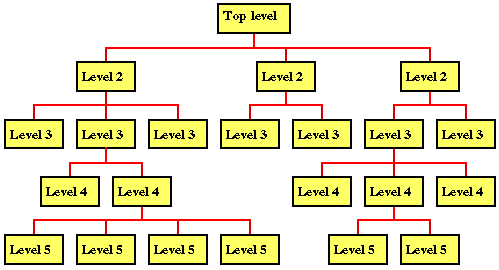
- Top (Highest Level): You look at the whole system: School Management System (SMS).
- Level 1 Decomposition: It is divided into 3 major modules:
- Module A: Student Management
- Module B: Faculty Management
- Module C: Fee Management
- Level 2 Decomposition (Breaking the Student Module further):
- Sub-Module A1: Student Admission
- Sub-Module A2: Student Attendance
- Sub-Module A3: Student Grade Report
- This process continues until we reach the smallest and simplest function (e.g.,
Save_Student_Data()).
2. Bottom-Up Design Approach (Bottom-Up Design)
The Bottom-Up approach works exact opposite of Top-Down. Here, we first build small, independent Modules, and then combine them to create the complete system.
What is this?
- Start: We begin from the Fundamental and Specific Components of the system.
- Process: Small Utility Functions are created and tested first.
- Focus: This approach focuses on Reusability and small Low-Level Tasks.
- Example Term: It is widely used in Object-Oriented Programming (OOP).
Example: Creating a Data Processing Library
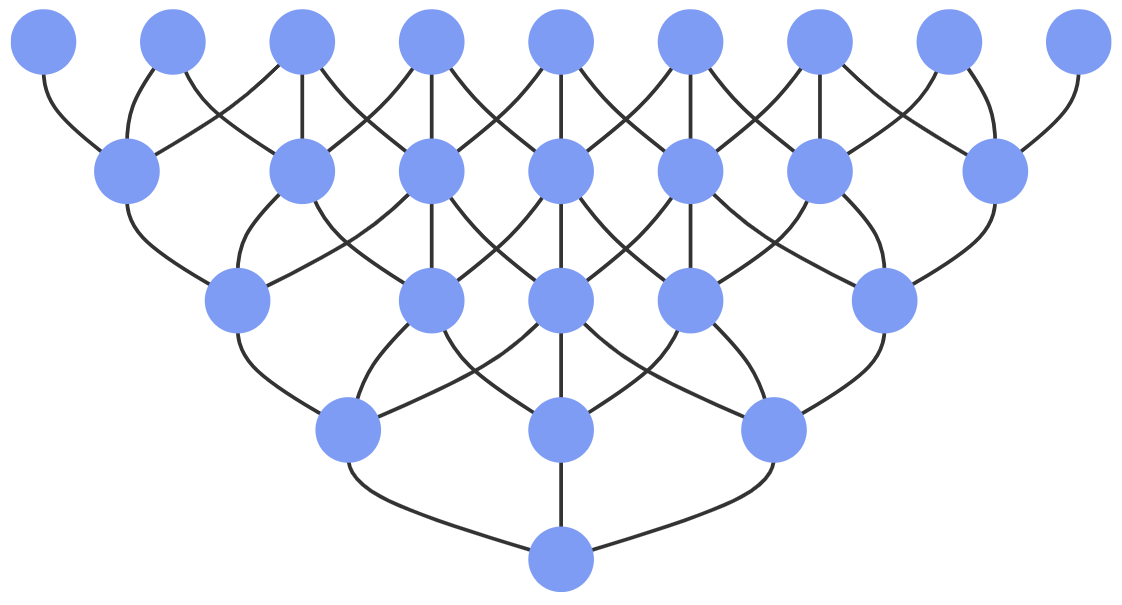
- Bottom (Lowest Level): You create small basic functions:
- Function 1:
Add(a, b) - Function 2:
Subtract(a, b) - Function 3:
SquareRoot(x)
- Function 1:
- Level 1 Combination:
- Module A:
Calculate_Hypotenuse(a, b)
- Module A:
- Top (Highest Level): Now all small and big modules are combined to form the Complete Math Library.
Comparison between Top-Down and Bottom-Up
| Feature | Top-Down Design | Bottom-Up Design |
|---|---|---|
| Flow | General → Specific | Specific → General |
| Approach | Decomposition | Integration/Composition |
| Focus | Overall System Structure | Reusable Components/Functions |
| Testing | Integration Testing becomes difficult later | Small Modules get tested early |
| Use Case | Procedural Programming (C, Pascal) | Object-Oriented Programming (Java, Python) |
In most large projects, the Designer first uses the Top-Down approach to build the structure of the system, and then the smaller modules are coded using the Bottom-Up method.


Comments
Post a Comment